Thursday, October 13, 2016

9) Chin Mee Chin Confectionary

Chin Mee Chin Confectionery

Address         : 204 E Coast Rd, Singapore 428903
Opening hours : Tuesday - Sunday, 0830 hrs - 1530 hrs 


This is one of the last remaining Hainanese coffee shops in Singapore. Can you find out what is so unique about it? 


Chin Mee Chin Confectionery is a famous and one of the last standing hainanese coffee shop here in Joo Chiat. The confectionery is famous for its kaya, a kind of custard jam. Unfortunately, the shop is closed during the day of our visit. According to the Singapore Infopedia, the baroque interior is accentuated by its defining floor tiles. The shop uses ceiling fans and marble tops, bringing us back to the feel of a coffee shop back in the 1950s. The confectionery has a unique way of making their kaya. They were made in "huge cauldrons heated over slow burning charcoals, releasing a sweet aroma". Bread toast and kaya, called "kaya toast", is still considered the traditional breakfast of Singaporeans.  Other specialities of the confectionery include eggs, coffee, curry puffs, sausage rolls and fruit cakes. The confectionery roasts its own coffee beans and bakes its own bread. In pre-independent Singapore, it was the Eurasian community that frequently patronised the shop before many migrated to Canada and Australia in the 1950s to 1960. The shop is a stone's throw away to the Church of the Holy Family. We believe that many Catholic worshippers going to the church every Sunday will definitely make some time to stop by to buy their signature kaya. It was a pity that we didn't get to taste their 'kaya toast'.

References:

"Chin Mee Chin Confectionary," National Library Board Singapore, accessed October 12, 2016,
http://eresources.nlb.gov.sg/infopedia/articles/SIP_618_2004-12-15.html

8) Church of the Holy Family

Church of the Holy Family

Address            : 6 Chapel Road, 429509 


Th church of the holy family is a Roman Catholic Church catered to the Eurasian community in Joo Chiat. Its history can be traced back to 1902 as it was founded by Eurasian families and was only built in 1923. The beginnings of the church was only one storey high. The church building we see today was as a result of a huge renovation works to reconstruct the church in 1997. The front sculptures have been retained to preserve the original church structure. Today, the 4-storey air-conditioned has a distinctive facade, stained glass windows, more comfortable seating and parking space at the void deck. The space can now hold up to 2000 worshippers. The modern day church remains active in providing services for the local Catholic community.

References:

'Church of the Holy family," National Library Board Singapore, 2004,

7) Joo Chiat Community Club

Joo Chiat Community Club:

Address         : 405 Joo Chiat Rd, 427633
Opening hours : Monday - Sunday, 0900 hrs - 2200 hrs

Now, let me introduce to you the Joo Chiat Community Club!  


Hard to believe, it was once a simple wooden hut with facilities like library, boy’s club and basketball courts.

The difference between the past and the present can be seen from here:

Now, there are a total of 4 levels in the community club.
This is how a typical room looks like now.


This shows the NUMEROUS brochures that are pasted in the lift.

As you can see from our photos, the community club has undergone numerous renovations until what it looks like today. Until now, it remains as an important meeting point for the community. From the photos, I feel that the community club is very self-sufficient with their very own sport facilities as well as overwhelming array of different courses to cater to the various interests of the residents. The community club also provides legal service on two days, for a duration of 2 hours from 730pm to 930pm, for each month. This legal clinic started quite recently since 21st July 2016. It is quite uncommon to see community clubs in Singapore to provide legal service, so I would say Joo Chiat Community Club is considered a four or five star community club (without considering their service).


References:


"Rediscover the East: Katong and Joo Chiat," Urban Development Authority, accessed July 28, 2016,

6) Former Joo Chiat Maternal and Child Health Clinic

Joo Chiat Maternal and Child Health Clinic:

Address: 467 Joo Chiat Rd, Singapore 427678 
Opening hours: Monday - Saturday, 0830 hrs - 1630 hrs

Not far away from Joo Chiat Community Club, there used to be a very distinct and conspicuous red building. That building is the Joo Chiat Maternal and Child Health Clinic, established in the 1907. Interestingly, it was set up to deal with the high infant mortality rate in Singapore at the period of time. However, after the World War II, the clinic shifts its focus to cater to the nation’s general public who was badly affected during the Japanese Occupation. This clinic is no longer there and it is being replaced by Scanteak, a white building that sells furniture. 


"Rediscover the East: Katong and Joo Chiat," Urban Development Authority, accessed July 28, 2016,

"Service to the Community," Katong & Joo Chiat, accessed October 13, 2016,

5) Shophouses along Koon Seng Road

Shophouses along Koon Seng Road                                                 

Address: 287 Joo Chiat Road, Singapore 427540 


Koon Seng Road was once, known as Lorong East Coast, before it is named after Cheong Koon Seng, a businessman, in 1934. 

As a highlight and attraction of Koon Seng Road, the shophouses along Koon Seng Road is a must-visit. 


Look at the colourful and exquisite exterior of each and every building and you will know why. These beautifully coloured pre-war shophouses can be seen lined up neatly in two rows and they seem to be heavily influence by the Peranakan culture. These are definitely examples of Singapore’s architectural heritage. Looking at the designs, they are exceptionally ornate with sophisticated details, suggesting a fusion of Eastern and Western influence. Some of these shophouses have been featured in books and some even won awards for their well-designed spaces. Most of the shophouses here are built in the 1920s and they have been announced to be preserved since 1991. From the exteriors of the buildings, I feel that the conservation effort is really well-done.


References: 

"Koon Seng Road," National Library Board Singapore, accessed 2006,

"Rediscover the East: Katong and Joo Chiat," Urban Development Authority, accessed July 28, 2016,

4) Kuan Im Tng Temple

Kuan Im Tng Temple

Address: 62 Tembeling Rd, Singapore 423586

The weather was merciless. Fatigue took over as we reached our final stop. This explains the agonising face Yan Kai is showing. But it is finally our last stop!

Picture: Kuan Im Tng Temple (Close Up)

Picture: Kuan Im Tng Temple (Overall)

The temple was closed on that day itself, but like any other temples, this one consists of several statues and artefacts of worship. However, through some observations, there seem to be a mixture of idols from different religious beliefs within the temple. This is rather intriguing.

Further research showed that the temple was built on the land in 1921. The whole temple was small in size and it was surrounded by the coconut plantations back then. The temple was renovated in 1972 and further expanded in 1988.

This temple has its significance in terms of the god the Chinese worships. The god that is prevalent in the temple is the Kuan im, the goddess of peace. Since the villages back then around the area consists of fishermen, it would be relevant that the temple provides them with the area of worship, to seek peace and favour with the god so to avoid accidents in the water.

Moreover, this temple is one that combines three different Chinese religious beliefs, Buddhism, Taoism and Confucianism. This explains my suspicion as I could see idols of different religious beliefs within one temple itself. Therefore, this temple is not just a place of worship but it also unites the Chinese community regardless of their religious stands. No wonder this temple is preserved for its significance in uniting the chinese community as a whole.

References
“About,” Kuan Im Temple (Joo Chiat), accessed October 12, 2006, http://www.kuanimtng.org.sg/The-Temple

3) Lotus at Joo Chiat


Lotus at Joo Chiat

Address: 89 Joo Chiat Place, Singapore 427806

Lotus at Joo Chiat is a service apartment which consisted of several shop houses which have been preserved, restored and ultimately refurbished. These service apartments draws on the rich heritages and cultures of the Peranakans and Eurasians communities in the area to attract working professionals, mostly foreigners to live in such accommodations where they would be able to experience the rich cultures in these areas and immerse themselves in it.

These shop houses have really been well restored and were elegant and from our observation, the people who we see walking along these streets are Caucasian who are likely to be foreigners.
It was quite evident that the target customers of these service apartment were people of greater purchasing power and we being students did feel a bit out of place in this area.


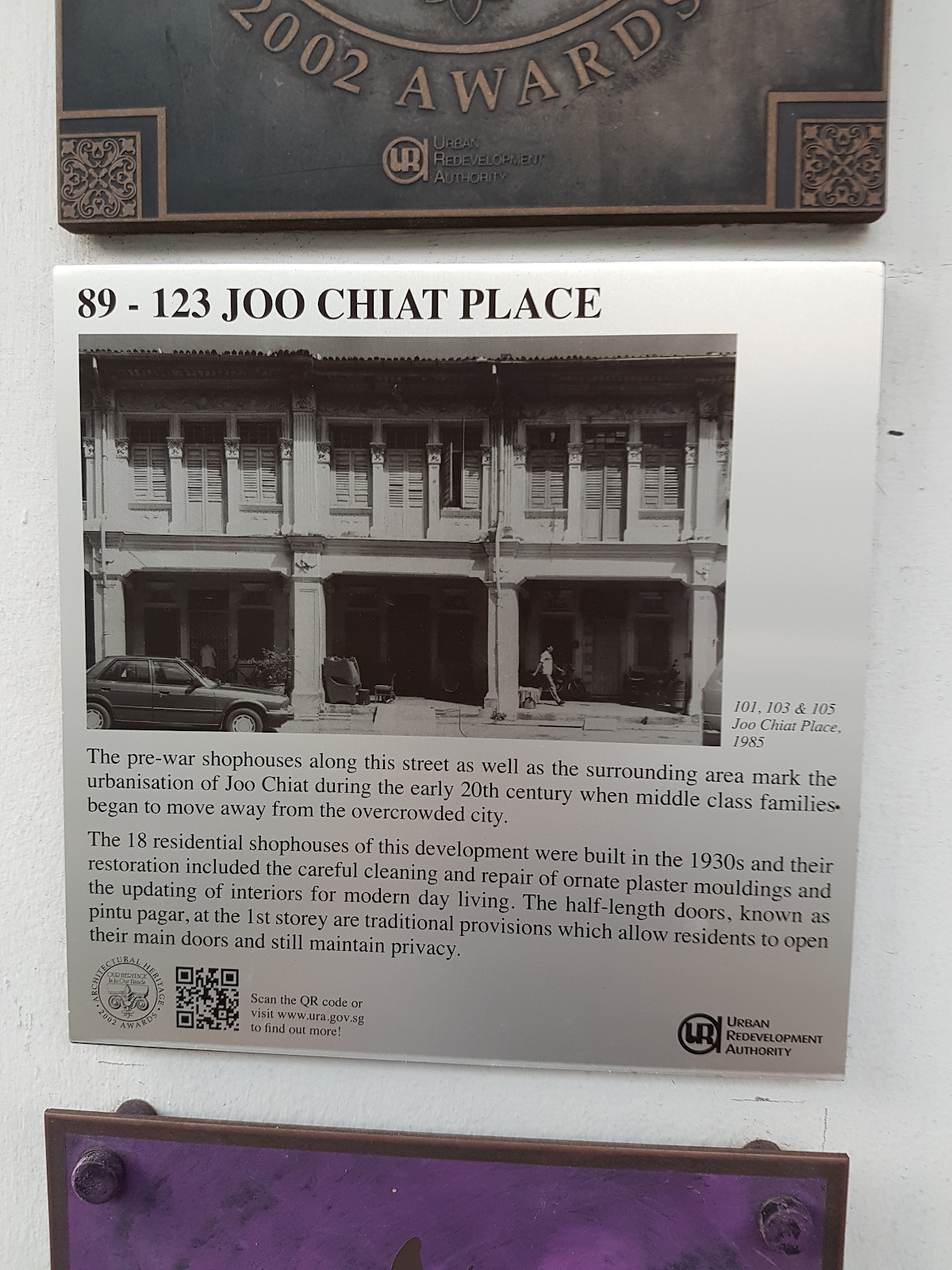
However, we did learn something new about the Peranakans from the design of their houses and is that the most Peranakan houses had a Pintu Pagar (refer to image on below: the wooden structure that Yankai is intently staring at) which acts as a half length door which allows residents to open up their main doors but still maintain a certain amount of privacy. This seems to suggest the existence of the kampong spirit where neighbours within the same community trust each other enough to leave their doors open with the mentality and confidence that their items would not be stolen by their neighbours.


The information which we obtain the information with regards to the Pintu Pagar was through the small information board provided by the Urban Redevelopment Agency (URA). So be sure to keep your eyes on the look-out for these board as they often contain nuggets of interesting information about the cultures of the local community in the area.